WordPress vs. Wix in India: Which One Should You Actually Use?
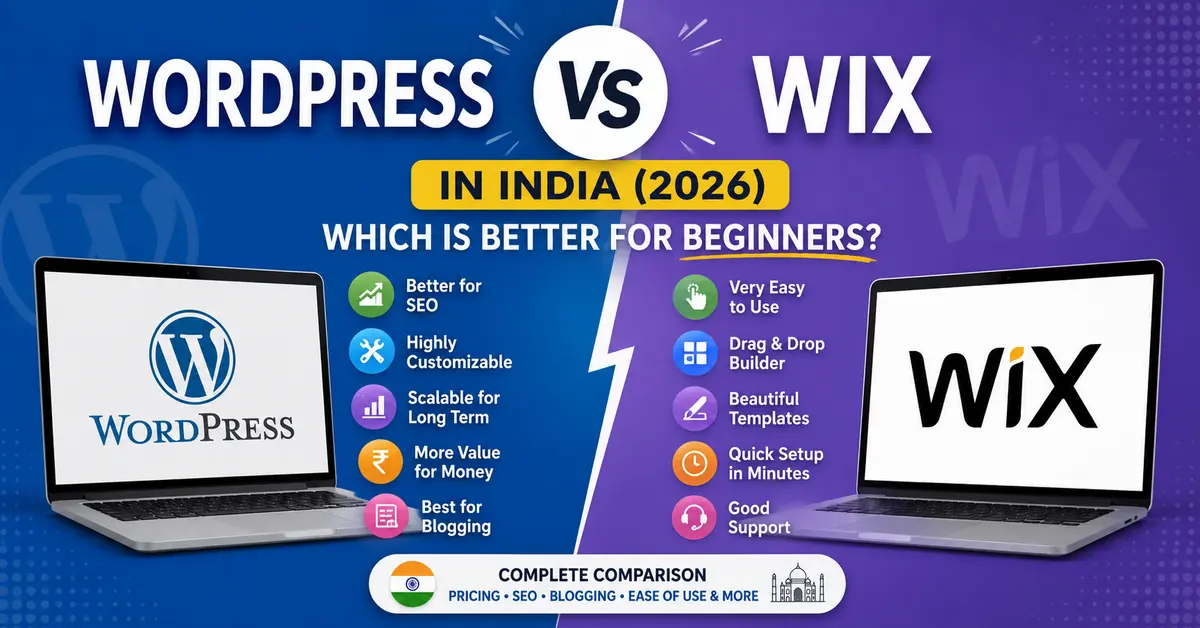
WordPress vs Wix India is one of the biggest decisions beginners face when creating their first website in 2026.
If you’ve ever tried to build a website in India, whether for your small business, a blog, or an online store, chances are you’ve heard two names pop up more than anything else: WordPress and Wix.
And if you’ve spent more than 10 minutes researching them, you’ve probably ended up more confused than when you started.
One person says, “WordPress is the best; it’s what all professionals use.” Another says, “Just use Wix, it’s so much easier.” And somewhere in between, you’re sitting there wondering which one is actually right for me?
It’s a fair question. Honestly, it’s one of the most common dilemmas for first-time website owners in India, from freelancers in Bangalore trying to showcase their portfolios, to shop owners in Surat wanting to take their businesses online, to students and bloggers who want a clean space to share their thoughts.
Here’s why the confusion is so widespread:
WordPress vs Wix India: Quick Comparison
- Simplicity: Wix promises you can build a website in minutes with zero technical knowledge. WordPress, on the other hand, has a steeper learning curve, but is that really a dealbreaker?
- Pricing: Both platforms have free and paid options, but the real costs, especially when you factor in Indian hosting providers, domain pricing, and GST, aren’t always obvious upfront.
- SEO: If you want your website to show up on Google, which platform actually gives you the tools to get there?
- Website Growth: What works fine for a 5-page website today might completely hold you back when your business scales tomorrow.
The truth is, there’s no universal answer, but there is a right answer for your specific situation. And that’s exactly what this article is going to help you figure out.
We’ll break down WordPress vs. Wix across every factor that matters to Indian users, pricing in INR, hosting options, SEO capabilities, ease of use, and long-term scalability, so by the end, you’ll know exactly which platform deserves your time, money, and energy.
Let’s get into it.
Short on time? Here’s the simple version:
Choose Wix if you’re an absolute beginner, you need a website up and running quickly, and you don’t want to deal with any technical setup. It’s ideal for freelancers, small local businesses, or personal portfolio sites that don’t require heavy customisation or long-term scaling.
Choose WordPress if you’re serious about growing your website, whether it’s a blog, a business site, or an online store. It gives you complete control over your design, SEO, and functionality, and it’s the platform that professionals, agencies, and established brands trust worldwide.
In the Indian context specifically, if you’re a student or hobbyist just testing the waters, Wix gets you started without any friction. But if you’re a business owner, blogger, or entrepreneur who wants real results from your website over time, WordPress is almost always the smarter long-term investment.
The one-line summary: Wix is easier to start with. WordPress is better to grow with.
That said, the full picture is a lot more nuanced, especially when you factor in Indian pricing, hosting costs, regional SEO, and the kind of website you’re actually trying to build. So let’s break it all down properly.
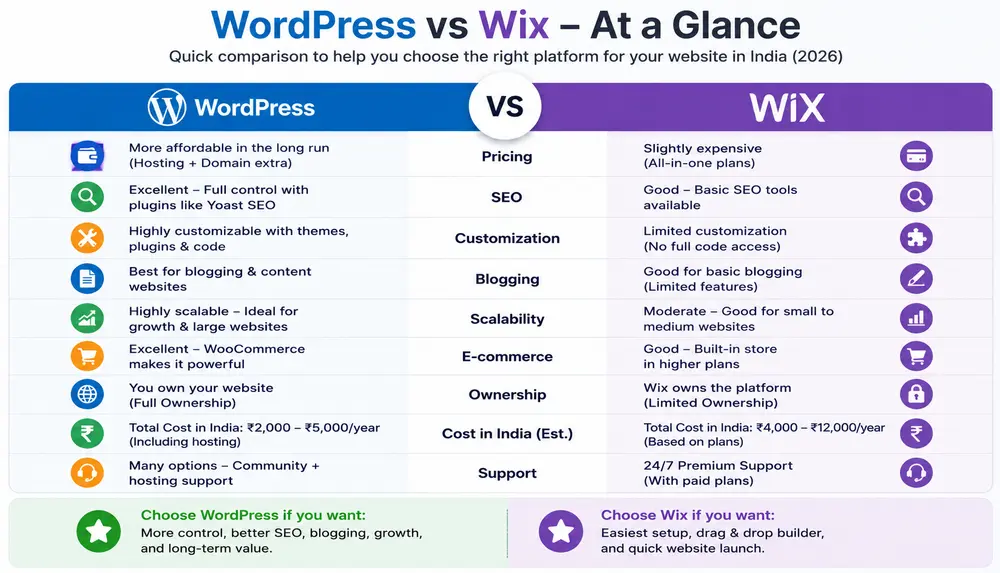
WordPress vs. Wix: Side-by-Side Comparison
| Factor | WordPress (Self-Hosted) | Wix |
|---|---|---|
| Pricing | Software is free; Hosting starts at ₹99–₹199/month in India + domain cost (₹700–₹1,000/year). Total can start from ₹2,000–₹3,500/year | Free plan available (with Wix ads); Paid plans start at approx. ₹1,300–₹2,500/month. Significantly more expensive annually |
| SEO | Excellent. Full control over meta tags, URLs, schema, sitemaps. Plugins like Rank Math & Yoast make it even more powerful | Excellent. Full control over meta tags, URLs, schema, and sitemaps. Plugins like Rank Math & Yoast make it even more powerful |
| Customisation | Virtually unlimited. 60,000+ plugins, thousands of themes, full code access if needed | Limited to Wix’s editor and App Market. Cannot edit source code freely |
| Blogging | Limited to Wix’s editor and App Market. Cannot edit the source code freely | Decent but basic. Functional for simple blogs, but lacks advanced content management feature |
| eCommerce | Excellent via WooCommerce. Supports Razorpay, PayU, COD & all major Indian payment gateways | Built-in Wix Stores. Supports PayPal & some Indian gateways, but less flexible than WooCommerce |
| Ads on Your Site | No forced ads ever, even on free hosting | Free plan displays Wix-branded ads on your website. Must upgrade to remove them |
| Ownership | You own everything — your content, data, design, and hosting | Wix owns the platform. You are a tenant — subject to their terms, pricing changes & policies |
| Ease of Use | Moderate learning curve. Requires initial setup, hosting configuration & plugin management | Decent but basic. Functional for simple blogs, but lacks advanced content management features |
What This Table Tells You
A few things stand out clearly when you look at this comparison from an Indian user’s perspective:
On pricing, Wix looks affordable at first glance, but the monthly subscription model adds up quickly. A mid-tier Wix plan can cost you ₹15,000–₹30,000 per year, whereas a solid WordPress setup with Indian hosting can cost as little as ₹3,000–₹5,000 per year, delivering far more value for money.
On SEO, if organic Google traffic matters to your business or blog, WordPress is the clear winner. The level of technical SEO control it offers simply isn’t available on Wix.
On ownership, this one is often overlooked by beginners, but it’s critical. With WordPress, your website is truly yours. With Wix, you’re essentially renting space on someone else’s platform, and if their pricing changes or their policies shift, you have limited options.
On ease of use, Wix genuinely wins here for absolute beginners. If the idea of setting up hosting makes you anxious, Wix removes that barrier entirely.
The table doesn’t declare one platform a winner across the board because there isn’t one. But it does make it very clear which platform is better suited for which type of user, and we’ll keep building on that picture in the sections ahead.
Here are all the remaining sections:
What is WordPress?
WordPress is the world’s most popular website-building platform, and it’s not even close. As of today, over 43% of all websites on the internet are built on WordPress. That includes everything from small personal blogs to massive news portals like TechCrunch, government websites, and even Fortune 500 company pages.
But what exactly is it?
In simple terms, WordPress is a free, open-source Content Management System (CMS), which basically means it’s a platform that lets you create, manage, and publish content on a website without needing to write code from scratch. You install it, pick a design, add the features you need, and you’re off.
Now, one important thing to clarify, because this trips up a lot of Indian beginners:
There are two versions of WordPress:
- WordPress.com is a hosted version where WordPress manages everything for you. Limited flexibility, but easier to start.
- WordPress.org: The self-hosted, fully open-source version. This is what most professionals mean when they say “WordPress.” You download the software for free and host it on your own server.
For this article, we’re talking about WordPress.org, the one that gives you full control.
Why Do So Many People in India Use WordPress?
1. Unmatched Flexibility Whether you want a simple blog, a business website, a photography portfolio, an e-commerce store, or even an online course platform, WordPress can handle all of it. You’re never boxed into a template or a set of pre-defined features.
2. Thousands of Plugins Think of plugins as apps for your website. WordPress has a library of over 60,000 free and paid plugins that let you add almost any functionality imaginable, contact forms, SEO tools, payment gateways, WhatsApp chat buttons, booking systems, and much more. Popular Indian payment gateways like Razorpay and PayU integrate seamlessly with WordPress.
3. SEO-Friendly by Nature WordPress gives you deep control over your on-page SEO, meta titles, descriptions, URLs, schema markup, sitemaps, and more. With plugins like Yoast SEO or Rank Math, even beginners can optimise their content for Google with ease.
4. Hosting is Your Choice. With WordPress.org, you need to arrange your own hosting, but that’s actually a good thing. You get to choose a hosting provider that suits your budget and requirements. In India, providers like Hostinger, Bluehost India, SiteGround, and BigRock offer WordPress hosting plans starting as low as ₹99–₹199 per month, making it very accessible.
5. Built for Blogging and Beyond WordPress was originally built as a blogging platform, and that DNA still shows in the best possible way. It has one of the most intuitive content publishing systems available, making it a favourite among Indian bloggers, journalists, and content creators who publish regularly.
The One Catch
WordPress does come with a learning curve. Setting up hosting, installing WordPress, configuring plugins, and managing updates can feel overwhelming if you’re a complete beginner. But here’s the thing: millions of Indians have figured it out, and with the amount of Hindi and English tutorial content available on YouTube today, it’s far more approachable than it used to be.
Once you get past that initial setup, the freedom and power WordPress gives you is genuinely hard to match.
Here’s the What is Wix? section:
What is Wix?
If WordPress is the professional’s workshop full of powerful tools that reward skill and patience, then Wix is the ready-to-use studio apartment beautifully designed, fully furnished, and ready to move into the same day.
Wix is a cloud-based website builder that lets you create a fully functional website without touching a single line of code, without purchasing separate hosting, and without configuring anything technical. Everything the builder, the hosting, the domain management, the design tools- is bundled together in one place.
Founded in 2006 and headquartered in Tel Aviv, Wix today powers over 250 million websites across the world, and has built a strong user base in India, particularly among small business owners, coaches, photographers, and first-time website creators who want results without the technical headache.
The Drag-and-Drop Builder Wix’s Biggest Selling Point
The heart of Wix is its drag-and-drop website editor. And it’s genuinely impressive.
Here’s how simple it is: you pick a template, click on any element on the page (a heading, an image, a button), and drag it wherever you want. Want to change the font? Click it. Want to swap an image? Click it. Want to add a new section? Choose from a menu and drop it in.
There’s no backend to configure, no plugin conflicts to troubleshoot, and no FTP access required. What you see on screen is exactly what your visitors will see, which in the web development world is called a WYSIWYG (What You See Is What You Get) editor, and Wix has one of the best in the business.
What Makes Wix Convenient for Indian Beginners?
1. Zero Technical Setup: With Wix, there’s no hosting to purchase separately, no WordPress installation, no database configuration. You sign up, pick a template, and start editing. A complete beginner can have a live website in under an hour, sometimes even less.
2. Beautiful Templates: Ready to Go, Wix offers over 900 designer-made templates across categories like restaurants, salons, fitness studios, portfolios, online stores, and more. For Indian small business owners who want a professional-looking site without hiring a designer, this is a huge advantage.
3. Wix ADI: Let AI Build It for You. Wix has a feature called Wix ADI (Artificial Design Intelligence), where you answer a few simple questions about your business, and the platform automatically generates a complete website for you with relevant content, images, and layout. It’s not perfect, but for someone with zero design sense, it’s a surprisingly decent starting point.
4. Everything Is Managed for You: Security updates, server maintenance, performance optimisation, SSL certificates. Wix handles all of it behind the scenes. You never have to worry about your website getting hacked because you forgot to update a plugin, or going down because your hosting plan had an issue.
5. Built-In Features for Common Needs: Wix comes with a solid set of built-in tools: a blog, an online store, a booking system, a contact form, social media integration, and even email marketing. For many small Indian businesses, these built-in features are more than enough to get started without spending on third-party tools.
The Honest Limitations
Wix’s simplicity is its greatest strength, but it’s also the source of its biggest limitations.
Once you’ve built your Wix website, you cannot switch templates without rebuilding your site from scratch. Your design flexibility, while great for beginners, has a ceiling. And as your business grows and your needs become more complex, with custom functionality, advanced SEO control, and large-scale content management, you may start to feel the walls closing in.
There’s also the matter of ownership. With Wix, your website lives on Wix’s servers, under Wix’s rules. You don’t truly own your platform the way you do with a self-hosted WordPress site.
But for a large number of Indian users who simply need a clean, functional, good-looking website without the complexity, Wix does exactly what it promises, and it does it well.
WordPress vs. Wix – Detailed Comparison
In this WordPress vs Wix India comparison, we’ll help beginners choose the right platform for blogging, business websites, and long-term growth.
Ease of Use
Let’s be honest about this one because the experience of using WordPress versus Wix for the very first time is genuinely very different.
With Wix, the moment you sign up, you’re greeted with a clean, visual editor. You pick a template, click on anything you want to change, and edit it directly on screen. Want to move your logo to the left? Drag it. Want to change your headline? Click and type. There’s no dashboard to figure out, no settings to configure. A first-time user, even someone who has never built a website before, can have something that looks like a real, professional website within an afternoon.
With WordPress, the journey starts a step earlier, and that step matters. Before you even see a website editor, you need to:
- Purchase a hosting plan from a provider like Hostinger or MilesWeb
- Register a domain name
- Install WordPress (most hosts offer a one-click installer, which helps)
- Choose and install a theme
- Install essential plugins for security, SEO, and performance
For someone completely new to websites, this process can feel like assembling furniture without instructions. It’s doable, and millions of Indians have done it, but it takes time, patience, and a willingness to learn.
The practical difference? Imagine two people: Priya, a yoga instructor in Pune who wants a simple website to show her class schedule and collect enquiries, and Rohan, a finance blogger in Delhi who wants to rank on Google and eventually monetise his content. Priya will be up and running on Wix in a day. Rohan will spend a weekend setting up WordPress, but six months later, he’ll have a platform that can actually support his ambitions.
Verdict: Wix wins on ease of use for absolute beginners. WordPress becomes easier once the initial setup is done — and the investment in learning pays off quickly.
SEO Capabilities
Search Engine Optimisation is where the gap between WordPress and Wix becomes most significant, and for Indian bloggers and business owners who depend on Google traffic, this matters enormously.
WordPress gives you complete SEO control. With plugins like Rank Math or Yoast SEO (both free), you can:
- Set custom meta titles and descriptions for every page and post
- Create and submit XML sitemaps to Google Search Console
- Optimise your URL structure (slugs)
- Add schema markup for rich snippets, particularly valuable for local Indian businesses that want to appear in Google’s local search results
- Control canonical tags to avoid duplicate content issues
- Analyse your content’s readability and keyword optimisation in real time
WordPress also integrates effortlessly with Google Search Console and Google Analytics, essential tools for tracking your SEO performance in the Indian market.
Wix has improved its SEO significantly over the past few years, and to be fair, it’s no longer the SEO disaster it once was. It now offers meta tag editing, sitemap generation, and a basic SEO setup checklist. For a local business targeting simple keywords like “bakery in Nagpur” or “yoga classes in Kochi”, Wix’s SEO tools may be perfectly sufficient.
However, Wix still falls short of WordPress when it comes to technical SEO things like page speed optimisation, structured data control, advanced redirects, and log file analysis. These might sound intimidating as a beginner, but as your website grows and competition increases, these factors become increasingly important for ranking.
Verdict: WordPress is the clear winner for SEO, especially for bloggers, content websites, and businesses targeting competitive keywords in India. Wix is adequate for basic local SEO needs.
Pricing in India
This is a section that most international comparisons get completely wrong because they don’t account for Indian pricing realities. Let’s break it down properly.
Wix Pricing in India
Wix’s free plan exists, but it comes with Wix-branded ads on your website and no custom domain, which makes it unsuitable for any serious use. To get a usable website, you’ll need a paid plan.
Wix’s paid plans for Indian users are billed in USD and typically work out to approximately:
- Light Plan — ₹1,300–₹1,500/month (~₹15,600–₹18,000/year)
- Core Plan — ₹1,800–₹2,200/month (~₹21,600–₹26,400/year)
- Business Plan — ₹2,500–₹3,000/month (~₹30,000–₹36,000/year)
Keep in mind that GST (18%) applies on top of these figures for Indian users, which pushes costs even higher.
WordPress Pricing in India
WordPress.org software is completely free. Your costs are:
- Domain name — ₹700–₹1,000/year (from providers like BigRock, GoDaddy India, or Namecheap)
- Hosting — Starting as low as ₹69–₹199/month with Indian providers like Hostinger India or MilesWeb
- Premium theme (optional) — ₹2,000–₹5,000 one-time, or use a free theme like Astra or GeneratePress
- Premium plugins (optional) — Most essential plugins are free; paid ones are a one-time or annual cost
Realistic beginner budget for WordPress in India:
| Setup | Estimated Annual Cost |
|---|---|
| Domain + Basic Hosting (Hostinger/MilesWeb) | ₹2,500–₹4,000 |
| Free Theme + Free Plugins | ₹0 |
| Total (Year 1) | ₹2,500–₹4,000 |
Compare that to Wix’s minimum of ₹15,000–₹18,000 per year for a basic usable plan, and the difference is stark.
Verdict: WordPress is dramatically more affordable for Indian users, especially beginners on a tight budget. Wix’s pricing, when converted to INR and combined with GST, is considerably harder to justify for most Indian users.
Customisation & Growth
This is where WordPress doesn’t just win — it wins by a mile.
WordPress is essentially limitless in its customisation. Because it’s open-source, developers around the world have built thousands of themes and over 60,000 plugins that extend its functionality in almost every direction imaginable. Want to add a membership portal? There’s a plugin. A multilingual website for Hindi and English audiences? Done. A custom booking system, an LMS for online courses, a job board, a real estate listing portal? WordPress handles all of it.
More importantly, if you have the budget to hire a developer, any WordPress website can be custom-coded to look and function exactly how you need it to. This is why agencies and professional developers across India almost universally prefer WordPress for client projects; the platform never becomes the bottleneck.
Wix, on the other hand, offers a good range of customisation within its own ecosystem. The Wix App Market has over 300 apps for added functionality, and Wix’s editor is genuinely flexible for design. But there are hard limits. You cannot edit the underlying code freely, you cannot migrate to a different platform without rebuilding from scratch, and you are permanently dependent on what Wix chooses to offer.
Here’s a real-world scenario that illustrates the long-term problem with Wix: imagine you start a small clothing business in India on Wix. A year later, your business is growing, you need a custom product filter, a loyalty programme, integration with your warehouse management software, and a vernacular language option for Tier 2 city customers. On WordPress with WooCommerce, all of this is achievable. On Wix, you’ll quickly hit walls and migrating away from Wix is a painful, time-consuming process.
Verdict: WordPress is generally the better long-term choice for users who want flexibility and growth.
Blogging & Content Websites
WordPress was born as a blogging platform in 2003, and two decades later, that heritage still gives it a significant edge for content-heavy websites.
WordPress for blogging offers:
- A powerful, intuitive post editor (Gutenberg) with blocks for text, images, videos, tables, and more
- Advanced category and tag systems for content organisation
- Full control over post scheduling, author management, and editorial workflows
- Built-in RSS feeds and newsletter integration options
- The ability to handle thousands of blog posts without performance issues
- Deep integration with tools like Google Analytics, Search Console, Mailchimp, and ConvertKit
For Indian bloggers specifically, whether you’re writing about personal finance, travel, food, technology, or regional topics in Hindi or other vernacular languages, WordPress provides the infrastructure to grow a blog into a genuine media property over time. Many of India’s top blogs and digital publications, including several high-traffic Hindi blogs, run on WordPress for exactly this reason.
Wix does have a blogging feature, and for casual, low-frequency bloggers, it works just fine. You can write posts, add images, categorise content, and share on social media. But compared to WordPress, the blogging experience on Wix feels limited — especially when it comes to content organisation, SEO control per post, and the ability to scale to hundreds or thousands of articles.
Verdict: WordPress is the gold standard for blogging and content websites — no contest. If content is the core of your website, WordPress is the only serious choice.
Who Should Choose Wix?
Wix is not a bad platform; it’s simply the right platform for a specific type of user. And if you fall into any of the following categories, Wix might genuinely be the better choice for you.
Choose Wix if you are:
- A complete beginner with zero technical background who needs a website to live as quickly as possible without touching hosting, plugins, or any backend settings
- A local small business owner, a salon, restaurant, tuition centre, or boutique that needs a simple, good-looking website primarily for online presence and contact information
- A freelancer or creative professional photographer, designer, or musician who wants a portfolio site that looks beautiful without requiring ongoing technical maintenance
- A coach or consultant who needs a clean landing page with a booking form and a few service pages, nothing more, nothing less
- Someone building a temporary or short-term website for an event, a campaign, or a trial run where long-term scalability is not a concern
- A user who values convenience over control and is perfectly happy paying a premium for the simplicity of having everything managed in one place
In the Indian context specifically, Wix makes the most sense for Tier 1 city professionals and small business owners who are comfortable paying a higher monthly fee in exchange for a completely hands-off website experience — and who don’t rely on Google organic traffic as a primary source of customers.
Who Should Choose WordPress?
WordPress is the platform of choice for anyone serious about building a website that works hard for them, not just today, but over the long term.
Choose WordPress if you are:
- A blogger or content creator who plans to publish regularly and wants maximum SEO control to rank on Google and grow organic traffic
- A business owner who wants to build a scalable website that can grow alongside their business from a 5-page site today to a full eCommerce store or membership portal tomorrow
- An eCommerce entrepreneur who wants to sell products online using WooCommerce with full support for Indian payment gateways like Razorpay, PayU, and Instamojo
- A digital marketer or SEO professional who understands the value of technical SEO and needs a platform that supports it fully
- Someone on a tight budget who wants a professional, high-performing website without paying ₹15,000–₹30,000 per year
- A developer or agency building websites for clients who need custom functionality, unique designs, and complete code access
- Anyone who values true ownership of their website, their content, their data, and their platform without being subject to a third-party company’s pricing decisions or policy changes
The bottom line: If your website is a serious tool for your career or business — and not just a digital visiting card — WordPress is almost always the right answer. The learning curve is real, but it’s short. And everything you learn about managing a WordPress site is a transferable, valuable skill that pays dividends for years.
To get started with WordPress in India, you’ll also want to read our guide on How to Choose Web Hosting in India, which walks you through everything you need to know before purchasing your first hosting plan.
Best Hosting for WordPress Beginners in India
If you’ve decided to go with WordPress, great choice. Now, the single most important decision you’ll make next is choosing the right hosting provider. Your hosting affects your website’s speed, uptime, security, and overall performance. Here are three beginner-friendly options that work exceptionally well for Indian WordPress users:
1. Hostinger India ⭐ Best Overall for Beginners
Hostinger is arguably the most popular WordPress hosting choice among Indian beginners — and for good reason.
Pros:
- Plans starting as low as ₹69–₹99/month (on promotional pricing)
- Excellent page load speeds with LiteSpeed servers
- One-click WordPress installation
- Free SSL certificate and weekly backups
- 24/7 customer support via live chat
- Beginner-friendly hPanel control panel is much easier than traditional cPanel
Cons:
- Renewal prices are always higher than introductory rates. Always check the renewal cost before purchasing
- Entry-level plans limit you to a single website
Best for: First-time website owners, bloggers, and small business owners who want reliable performance at an affordable price.
2. MilesWeb ⭐ Best Indian Hosting Provider
MilesWeb is a homegrown Indian hosting company that has quietly built one of the best reputations in the Indian hosting market, particularly for WordPress sites.
Pros:
- Indian servers mean faster load times for Indian visitors
- Plans starting from ₹40–₹99/month
- Free domain name included with most plans
- 24/7 support with an India-based team (phone, chat, and email)
- 30-day money-back guarantee
- Supports Razorpay for INR billing — no forex charges
Cons:
- Less globally recognised than Hostinger or Bluehost
- The interface may feel slightly dated compared to competitors
Best for: Indian businesses and bloggers who want a local hosting provider with INR billing, Indian servers, and India-based customer support.
3. HawkHost ⭐ Best for Budget-Conscious Users
HawkHost is an underrated hosting provider that offers excellent value, especially for users who want reliable international hosting without paying a premium.
Pros:
- Highly competitive pricing with transparent renewal rates
- SSD storage across all plans for faster performance
- cPanel includes a familiar interface for those who prefer it
- Good uptime track record
- Supports multiple PHP versions, useful for developers
Cons:
- Support response times can occasionally be slower than those of Hostinger or MilesWeb
- Fewer India-specific features compared to local providers
Best for: Budget-conscious beginners and developers who want solid, no-frills hosting with transparent pricing.
For a more detailed breakdown of hosting options across different budgets, check out our guides on Best Web Hosting for Beginners and Best Cheap Web Hosting in India Under ₹100.
Final Verdict — WordPress vs. Wix for Indian Users
After going through every comparison point — pricing, SEO, ease of use, customisation, blogging, eCommerce, and long-term growth — here’s the honest, practical conclusion:
There is no single winner. But there is a right answer for you.
| Your Situation | Our Recommendation |
|---|---|
| Complete beginner, need a site fast | ✅ Wix |
| Local small business, simple presence | ✅ Wix |
| Blogger targeting Google traffic | ✅ WordPress |
| eCommerce store with Indian payments | ✅ WordPress |
| Tight budget, long-term plans | ✅ WordPress |
| Freelancer portfolio, no tech skills | ✅ Wix |
| Serious business website | ✅ WordPress |
| Short-term or temporary website | ✅ Wix |
The big picture for Indian users is this:
Wix is an excellent tool for getting online quickly and painlessly. If your website is a supporting element of your work — a place to send people for more information, and you don’t rely on it for traffic or revenue, Wix will serve you well without ever causing you stress.
But if your website is your business or if you want it to become one, WordPress is the platform that will grow with you. The slightly steeper learning curve at the beginning pays for itself many times over in the form of lower costs, better SEO, unlimited flexibility, and true ownership of everything you build.
In a country like India, where digital entrepreneurship is booming, and the competition for Google’s first page is intensifying every year, having the right platform foundation is not a small decision. WordPress gives you that foundation.
Start right. Build smart. And if you’re ready to take the first step with WordPress, begin with our guide on How to Choose Web Hosting in India — it’ll walk you through everything you need to get started on the right foot.
Frequently Asked Questions (FAQs)
Q1. Is WordPress better than Wix for SEO in India?
Yes, WordPress is significantly better for SEO. It gives you full control over technical SEO elements, meta tags, schema markup, URL structure, sitemaps, and more through powerful free plugins like Rank Math and Yoast SEO. Wix has improved its SEO features over time, but it still cannot match the depth of control that WordPress offers, particularly for competitive keywords in the Indian market.
Q2. Is Wix free in India?
Wix does offer a free plan, but it comes with Wix-branded advertisements displayed on your website and does not allow you to use a custom domain name. For any serious personal or business website, you’ll need a paid plan — which starts at approximately ₹1,300–₹1,500 per month for Indian users, plus GST.
Q3. How much does it cost to build a WordPress website in India?
A basic WordPress website in India can cost as little as ₹2,500–₹4,000 per year, covering domain registration and entry-level hosting from providers like Hostinger India or MilesWeb. The WordPress software itself is completely free, and most essential plugins and themes are also available at no cost.
Q4. Can I switch from Wix to WordPress later?
Technically, yes, but it’s not easy. Wix does not offer a direct migration tool to WordPress. Switching platforms typically means rebuilding your website from scratch on WordPress, which is why it’s important to choose the right platform from the beginning, especially if you’re planning for long-term growth.
Q5. Which is better for an online store in India — WordPress or Wix?
WordPress with WooCommerce is the better choice for most Indian online stores. It offers full integration with popular Indian payment gateways like Razorpay, PayU, and Instamojo, complete control over product pages and checkout flows, and far more flexibility for scaling your store. Wix Stores works well for very small or simple product catalogues, but it has limitations when it comes to advanced eCommerce functionality and Indian payment options.
Q6. Is WordPress difficult to learn for Indian beginners?
WordPress does have a learning curve, particularly around the initial setup involving hosting and domain configuration. However, there is an enormous amount of tutorial content available in both Hindi and English on YouTube and across the web, which makes it very approachable even for complete beginners. Most users find that within a week of regular use, the platform feels intuitive and manageable.
Q7. Which platform do professional web developers in India prefer?
The overwhelming majority of professional web developers and digital agencies in India work with WordPress. Its open-source nature, unlimited customisation potential, large developer community, and compatibility with virtually every third-party tool make it the industry standard for professional website development in India.