AI Website Builder vs WordPress (2026): Which Should You Choose?
Many beginners in 2026 are now asking the same question:
“Why should I use WordPress if AI can build a website in minutes?”
That’s honestly a fair question.
AI website builders are becoming extremely popular because they promise fast setup, drag-and-drop simplicity, and instant website generation using AI prompts. For someone creating their first website, that sounds much easier than learning WordPress.
At the same time, WordPress still powers a huge portion of websites across the internet because of its flexibility, blogging power, SEO advantages, and long-term scalability.
So which one should you actually choose?
In this AI Website Builder vs WordPress comparison, I’ll explain the real differences in simple language for beginners in India.
We’ll compare:
- Ease of use
- SEO and blogging
- Customization
- Pricing
- Ownership and control
- Long-term growth potential
By the end of this guide, you’ll know which platform fits your goals best.
If you’re completely new to website creation, you can also read our guide on How to Start a Website in India for a beginner-friendly step-by-step setup process.
AI Website Builder vs WordPress: Quick Answer
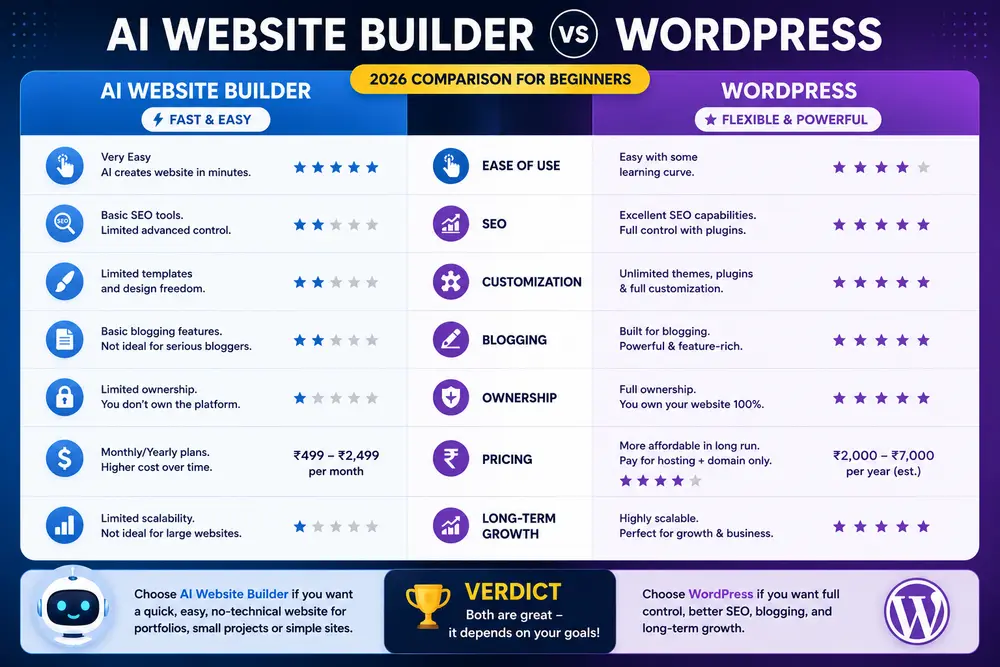
AI website builders are better for users who want the fastest and easiest way to launch a simple website.
WordPress is better for users who want long-term growth, blogging, SEO flexibility, customisation, and full ownership of their website.
For most beginners:
- Choose an AI website builder if you want a quick portfolio, temporary project, or basic business page.
- Choose WordPress if you want to build a blog, grow traffic from Google, run affiliate marketing, or scale a website long-term.
Quick Comparison Table
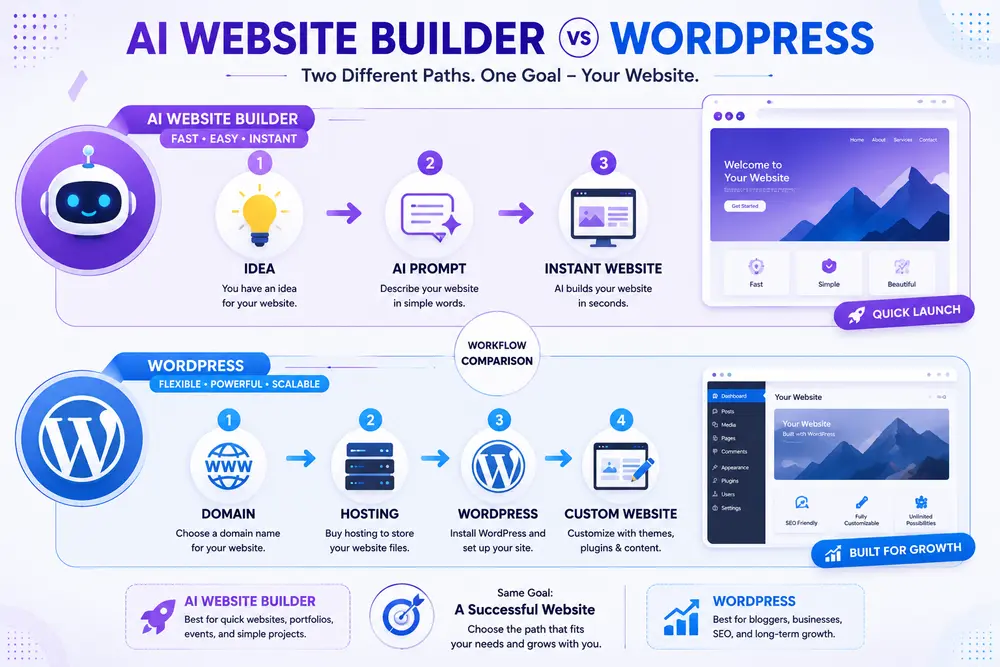
| Limited to advanced stages | AI Website Builder | WordPress |
|---|---|---|
| Ease of Use | Very easy — guided setup, no technical knowledge needed | Moderate — small learning curve at the start |
| SEO | Basic SEO tools included | Advanced SEO possible with plugins like Rank Math |
| Customisation | Limited to platform templates and editor | Virtually unlimited with themes and plugins |
| Long-Term Growth | Limited at advanced stages | Limited to advanced stages |
| Blogging | Basic blogging features available | Basic blogging features are available |
| Ownership | Platform owns your website infrastructure | The platform owns your website infrastructure |
| Pricing | Monthly subscription, costs add up over time | Monthly subscription costs add up over time |
| Speed to Launch | Very fast — website ready in minutes | Takes a few hours to set up properly |
| Best For | Quick Websites | Blogging & SEO |
What is an AI Website Builder?
An AI website builder is a platform that automatically creates websites using artificial intelligence.
Instead of manually designing pages, choosing layouts, and customising everything yourself, you simply answer a few questions or enter prompts.
The AI then generates:
- Website layouts
- Colors
- Text sections
- Images
- Navigation menus
- Basic design structure
Popular AI website builders focus heavily on simplicity and speed. For beginners, this feels much less intimidating than setting up WordPress manually.
The good part is that many AI website builders allow you to launch a website within minutes. However, simplicity also comes with limitations.
As your website grows, you may eventually want:
- Better SEO control
- Advanced blogging features
- More customization
- Faster performance optimisation
- Better monetisation options
That’s where WordPress usually becomes the stronger long-term choice.
What is WordPress?
WordPress is the world’s most popular website platform.
Unlike AI website builders, WordPress gives you complete control over your website.
You can:
- Install themes
- Add plugins
- Improve SEO
- Customise almost everything
- Build blogs, business websites, stores, communities, and more
WordPress does have a learning curve initially.
But the flexibility it provides is one of the biggest reasons bloggers, affiliate marketers, businesses, and publishers still prefer it in 2026.
Another important difference is ownership.
With WordPress, your website belongs to you.
You control:
- Hosting
- Files
- Content
- Monetization
- SEO settings
That level of control becomes extremely valuable if you plan to grow your website seriously.
AI Website Builder vs WordPress: Ease of Setup
If simplicity is your top priority, AI website builders definitely win here.
Most AI builders allow you to:
- Answer a few questions
- Choose a style
- Generate a website automatically
This process feels beginner-friendly and less technical.
You don’t need to worry much about:
- Hosting setup
- Plugins
- Theme installation
- Website configuration
WordPress, on the other hand, requires more setup initially.
You usually need:
- A domain name
- Hosting
- WordPress installation
- Theme customization
For complete beginners, this can feel overwhelming at first.
But once you learn the basics, WordPress becomes much more powerful.
Verdict:
- AI Website Builder = Easier for beginners
- WordPress = Slight learning curve, but more control
AI Website Builder vs WordPress for SEO
This is one of the most important differences.
If your goal is to get traffic from Google, SEO matters a lot.
AI website builders have improved their SEO features in recent years, but they remain somewhat limited compared to WordPress.
With WordPress, you get:
- Advanced SEO plugins
- Better content structure control
- Faster optimisation possibilities
- Technical SEO flexibility
- Better blogging ecosystem
For bloggers and affiliate marketers, these advantages become very important over time.
In reality, many successful content websites still rely on WordPress because it gives deeper SEO control.
AI builders work fine for:
- portfolios
- simple websites
- landing pages
- local business sites
But for serious blogging and long-term organic traffic growth, WordPress is usually the stronger platform.
Verdict:
- AI Website Builder = Basic SEO
- WordPress = Better long-term SEO flexibility
AI Website Builder vs WordPress for Blogging
If you want to build a blog, WordPress is still the better choice in 2026.
That’s because WordPress was originally designed for publishing content.
You get:
- Better blog organization
- Categories and tags
- Advanced plugins
- Content scalability
- Better SEO integration
- Easier monetization
Most AI website builders focus more on:
- fast website generation
- business pages
- portfolios
- landing pages
They are not always ideal for managing hundreds of blog posts long-term.
For most beginners who want:
- blogging
- affiliate marketing
- AdSense income
- SEO traffic
WordPress still provides much more flexibility.
AI Website Builder vs WordPress: Customisation & Flexibility
Customisation is where WordPress becomes extremely powerful.
With WordPress, you can customise almost every part of your website using:
- themes
- plugins
- page builders
- custom code
- SEO tools
- eCommerce integrations
AI website builders are intentionally simpler. That simplicity helps beginners initially. But it can also become restrictive later.
For example, you may eventually want:
- custom layouts
- advanced SEO changes
- affiliate integrations
- faster optimization
- plugin features
Many AI builders limit how much control you have.
WordPress gives far more long-term flexibility.
Verdict:
- AI Website Builder = Simple customisation
- WordPress = Advanced flexibility
Pricing in India
Pricing is another major concern for beginners. AI website builders usually work on monthly subscription models. This may look affordable initially, but long-term costs can increase. WordPress itself is free.
However, you still need:
- Domain name
- Web hosting
- Optional premium themes/plugins
The good part is that beginners in India can start WordPress websites at relatively low budgets.
Depending on your hosting provider, you can often start with:
- ₹100–₹300 per month
This gives much better long-term ownership and flexibility.
If you’re searching for affordable beginner plans, you can also explore our guide on Best Cheap Web Hosting in India Under ₹100.
Verdict:
- AI Website Builder = Simple monthly pricing
- WordPress = More flexible budget options
Ownership & Control
This is one of the biggest long-term differences.
- The platform controls the infrastructure
- Customisation can be limited
- Migration may become difficult
With WordPress:
- You own the website files
- You control hosting
- You can move providers anytime
- You have full website control
For serious website creators, this flexibility matters a lot.
Especially if your website becomes:
- a business
- a blog
- a monetised content platform
- an affiliate site
Verdict:
- AI Website Builder = Less control
- WordPress = Full ownership
Can You Move From an AI Website Builder to WordPress Later?
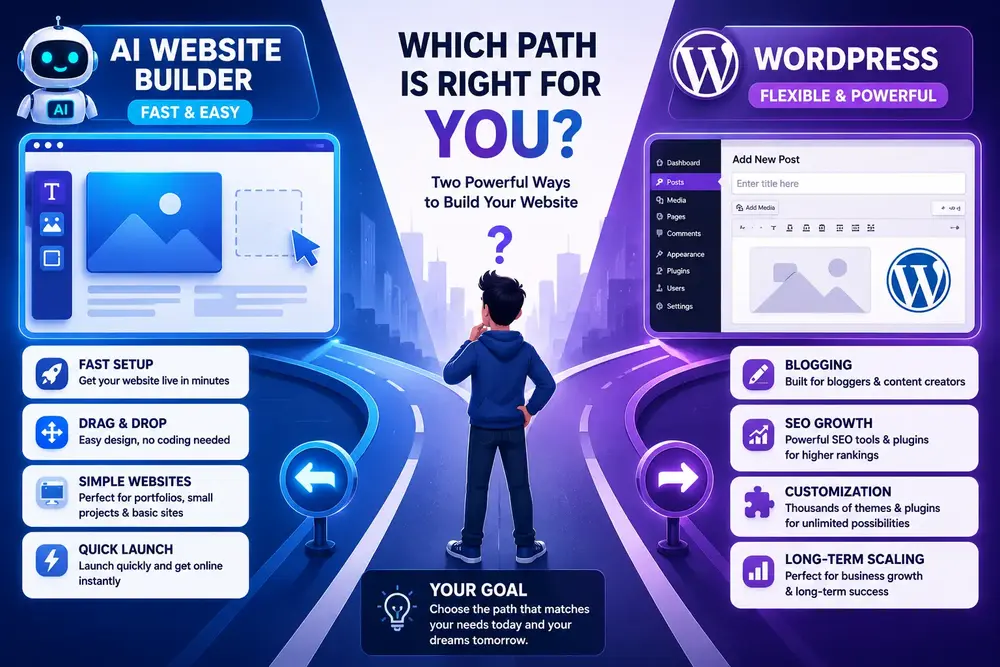
With many AI website builders:
Yes — but migration can sometimes be frustrating. This is something many beginners don’t think about initially.
When your website is small, AI website builders feel convenient.
But later, you may want:
- better SEO
- advanced blogging
- monetization
- more customization
- faster performance
At that stage, many users migrate to WordPress.
The challenge is that not all AI builders make migration easy.
You may need to:
- manually move content
- redesign pages
- rebuild layouts
- fix SEO settings
That’s why it’s smart to think about your long-term goals before choosing a platform.
My Honest Experience Using WordPress Since 2015
I started using WordPress around 2015 when I was experimenting with blogging and different website ideas. Back then, I tried multiple hosting providers, including Bluehost, HostGator, and FastComet, while learning how websites actually work.
Like most beginners, I was initially confused by domains, hosting dashboards, themes, plugins, SEO, and website speed optimisation. WordPress definitely has a learning curve compared to modern AI website builders, but over time, I realised that flexibility is the biggest advantage of WordPress.
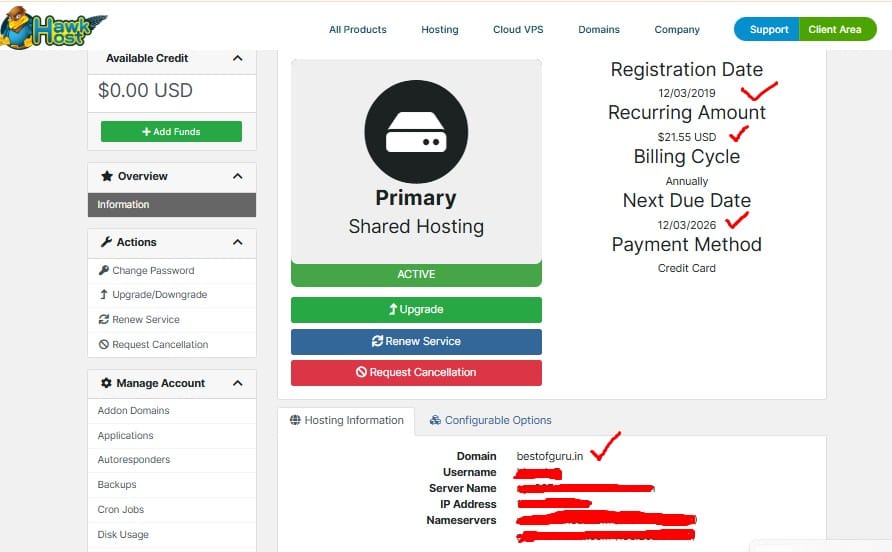
Since 2019, I’ve been hosting my websites on HawkHost and managing multiple WordPress sites for blogging and content projects. One thing I genuinely like about WordPress is that it gives full control over the website. You can customise almost everything, improve SEO properly, add features using plugins, and scale the site as your traffic grows.
At the same time, I also understand why many beginners now prefer AI website builders. They are much faster and easier to start with, especially for portfolios, simple business pages, or temporary projects.
But in my experience, if your long-term goal is blogging, SEO traffic, affiliate marketing, content publishing, or building a scalable website business, WordPress still offers much more flexibility and growth potential in the long run.
💡 For beginners who decide to use WordPress, choosing reliable hosting is important. I’ve personally been using HawkHost since 2019 for multiple websites, and it has worked well for my blogging and content projects so far.
👉 Check HawkHost Hosting Plans: [60% Special Discount Offer] – Use Promo Code BESTOFGURU during checkout.
Who Should Use AI Website Builders?
AI website builders are suitable for users who:
- want quick setup
- dislike the technical configuration
- need simple websites
- want drag-and-drop simplicity
- need temporary websites
- want portfolios or landing pages
For many small local businesses and beginner creators, AI builders can be enough initially.
Especially if:
- SEO is not the main focus
- Blogging is minimal
- long-term scaling is not important
Who Should Use WordPress?
WordPress is better for users who:
- want to grow traffic from Google
- plan to blog regularly
- want full customization
- care about SEO
- want monetisation flexibility
- plan long-term growth
If your goals include:
- affiliate marketing
- AdSense
- content publishing
- niche blogging
- scalable business websites
Then WordPress is usually the smarter long-term investment.
You may also want to read our detailed comparison of WordPress vs Wix India if you are still comparing beginner website platforms.
Best Hosting for WordPress Beginners in India
If you decide to use WordPress, choosing good hosting becomes important.
For beginners in India, some popular options include:
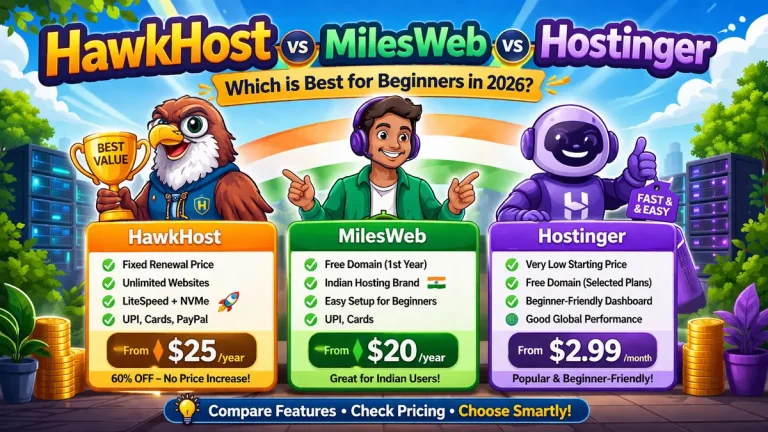
Hostinger
Good for beginners who want simplicity, speed, and beginner-friendly dashboards.
MilesWeb
Popular among Indian users because of local pricing and India-focused support.
HawkHost
A budget-friendly hosting provider I’ve personally used since 2019 for multiple WordPress websites.
When choosing hosting, focus on:
- uptime
- support quality
- pricing
- ease of use
- website speed
instead of only marketing claims.
If you are still confused about choosing hosting, check our detailed guide on Best Web Hosting for Beginners and Which Hosting Is Best for Small Websites.
Final Verdict: AI Website Builder vs WordPress
Choosing between an AI Website Builder vs WordPress depends mainly on your long-term goals.
If you want:
- the fastest setup
- minimal technical work
- a simple business or portfolio website
Then, AI website builders can be a good starting point.
But if your goal is:
- blogging
- SEO growth
- affiliate marketing
- customization
- full ownership
- long-term scalability
Then WordPress is still the stronger platform in 2026.
For most beginners who want long-term growth, blogging, and SEO flexibility, WordPress remains the smarter long-term choice.
FAQs
Is WordPress better than AI website builders for SEO?
Generally, yes. WordPress provides more advanced SEO control, plugin support, and blogging flexibility for long-term organic growth.
Can AI website builders rank on Google?
Yes, AI website builders can rank on Google, especially for simple business websites and local projects. However, WordPress usually offers stronger long-term SEO flexibility.
Which is cheaper in India: AI website builders or WordPress?
WordPress can often be cheaper long-term because you can choose flexible hosting plans based on your budget.
Is WordPress difficult for beginners?
WordPress has a learning curve initially, but many beginners learn it quickly with practice and tutorials.
Can I move from an AI website builder to WordPress later?
Yes, but migration can sometimes require manual work depending on the platform you use.